|
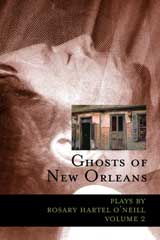
Ghosts of New Orleans: Plays by Rosary Hartel O'Neill Volume
2
Sex, money and decadence among the upper classes
in 19th century New Orleans and abroad.
|
6 Plays of historic New Orleans
368 Pages, illustrated.
Volume Two contains historical plays, mostly Victorian,
with characters driven by stratified society and
tradition. Knowledge of New Orleans history made me want
to adapt Uncle Vanya. I loved the play but felt its
details were too Russian. I took the bones of Vanya and
put it on a plantation called Waverly, the last
sugarcane plantation in Louisiana, and called my play
Uncle Victor. That play won a number of awards and
hooked me on historical drama. I also researched Edgar
Degas' visit to New Orleans in 1872 and wrote a
nine-cast show, so struck was I by all Degas' relatives
who had lived with him in 1872. Degas had tried to save
his Uncle's failing cotton business and create new roots
in the city of his mother. He fell prey to scandal and
decadence.
My plays are historically accurate. Obviously, you take
a scenario and expand the story but the main facts: the
births, deaths, relationships are all to the best of my
knowledge correct.
I spent days visiting Kate Chopin's house in
Cloutierville, La. and interviewed descendents of
Chopin's lover Albert Sanpitie and town members about
the scandals of her life. I researched in French and
English all the books on Degas. I did similar research
in New York and Paris for Beckett at Greystones Bay and
John Singer Sargent and Madame X, which are loosely tied
to New Orleans. A major theme in my work is the struggle
of an artist, the sacrifices made to maintain sanity.
We are glad Degas did go back to Paris and paint and
didn't succumb to the temptations of New Orleans. We are
pleased Sargent refused to change his scorned portrait
of Madame X and that Kate Chopin forged a way to raise
her six children and still write.
|
|
|
CLICK HERE TO ORDER THIS BOOK
|
|
|
Reviews of "Ghosts of New Orleans"
WONDERFUL !!! - Julie on October 1, 2008
GHOST OF NEW ORLEANS is an amazing assortment of historical plays of
New Orleans over the last 150 years. We meet famous characters and
are thrown into illicit love scenes behind closed doors in old New
Orleans. Where else but with O'Neill can you confront Edgar Degas,
Sarah Bernhard, Madame X and John Singer Sargent. She takes us to
New Orleans and thrusts us into the blissful and treacherous lives
of New Orleanians who have gone before. Plays are full of intrigue
and humor. Most are easy to stage--requiring nothing more than
imagination and the talent of the actor. This is a masterful book of
theatre whose crowning piece may be the strange and alluring BECKETT
AT GREYSTONES BAY.5.0 out of 5 stars
Artists Under Siege: later plays by Rosary O'Neill
- Brendan Mccall on October 7, 2008
This second volume of Rosary O'Neill's plays features a trilogy of
works that center on the role of the artist and the larger
culture--'Beckett at Greystones Bay,' 'Degas in New Orleans,' and
'John Singer Sargent and Madame X'. The shift in these plays perhaps
mirror Dr. O'Neill's own shifting of identity--leaving New Orleans
after Hurricane Katrina and re-inventing herself as a writer in New
York City. Much like James Joyce, who wrote passionately about
Dublin since living in Continental Europe in the 20th century, Dr.
O'Neill's plays on the artist center on the individual's efforts to
find truth, authenticity, and integrity in a world frequently
corrupt, self-serving, and dispassionate to the needs of the
creative temperament. Given the near-collapse of the US financial
system in recent news, and the government response to it, this
(unfortunately) is no longer a condition that only artists of the
past can experience. Dr. O'Neill's works continue in their
originality here, but become more textured and dense as poetic
dramas, mixing history with 'possible encounters' between real and
imagined figures. A wonderful collection! Also, as a director of 3
of her plays (so far), I know that she is an incredibly prolific
writer, and that there are at least two new plays that she has
written since these works were published in the spring of 2008! A
wonderful introduction to an exceptional dramatist!
Kansas, MO
- A Kid's Review on October 17, 2008
An authentic voice of her native New Orleans, O'Neill has put
together an extraordinary collection of mostly Victorian plays in
her GHOSTS OF NEW ORLEANS. She follows in the path of legendary
southern writers: Faulkner, McCullers, Hellman, and Williams. Her
native Louisiana unfolds in20a complexity and diversity rarely seen
or read about. Historical characters are marked with contemporary
feeling and take life on stage. O'Neill has invigorated history with
her passionate dialogue and spirited characters. A poetic quality
and intensity of meaning reveals the experienced hand of the
dramatist. THE AWAKENING OF KATE CHOPIN was so brilliantly styled
and delightfully engaged that I long to see it stage. The fine
heritage and passionate life of Louisiana natives like Uncle Victor
give us insight into the soul and breeding of old style New
Orleans.The city thrives again under O'Neill's brilliant staging.
Historic and Dramatic New Orleans
- Reader from New Jersey on July 17, 2008
This second volume of plays collects work of much produced and
honored Rosary Hartel O'Neill set in and about her home town of New
Orleans, Louisiana. The Plays in GHOSTS are historical- about
figures like Edgar Degas and John Singer Sargent's Madame X who all
had New Orleans connections. The LOUISIANA GENTLEMAN plays are about
people in New Orleans in the recent past- in the years just before
Hurricane Katrina. The characters in all cases are vivid and
naturally dramatic- there is a joie de vivre in language, in
emotion, even in struggle. Everyone seems born to be on stage- that
is, the characters see themselves as having dramatic, expressive,
and meaningful lives- and readers are pulled in and believe it too.
The characters and the city seem equally essential here; one feels
enriched and enlivened for having encountered them.
Definite page turner!
- Kelly S. Williams on October 4, 2008
GHOSTS OF NEW ORLEANS is a lurid collection of tales mostly
historical about famous characters who have ties to New Orleans.
Written in a bright contemporary style, the plays whisk you to the
Degas House (which still
exists in New Orleans) and to the home of legendary author Kate
Chopin among others. O'Neill meets her stride in tales of the
Victorian era and post-civil war New Orleans. Danger and surprise
ignite the plays with a fire that makes the stories pop off the
page. A wondrous collection of plays on old New Orleans with
remarkable new flair.
|